Sixty-five Degrees
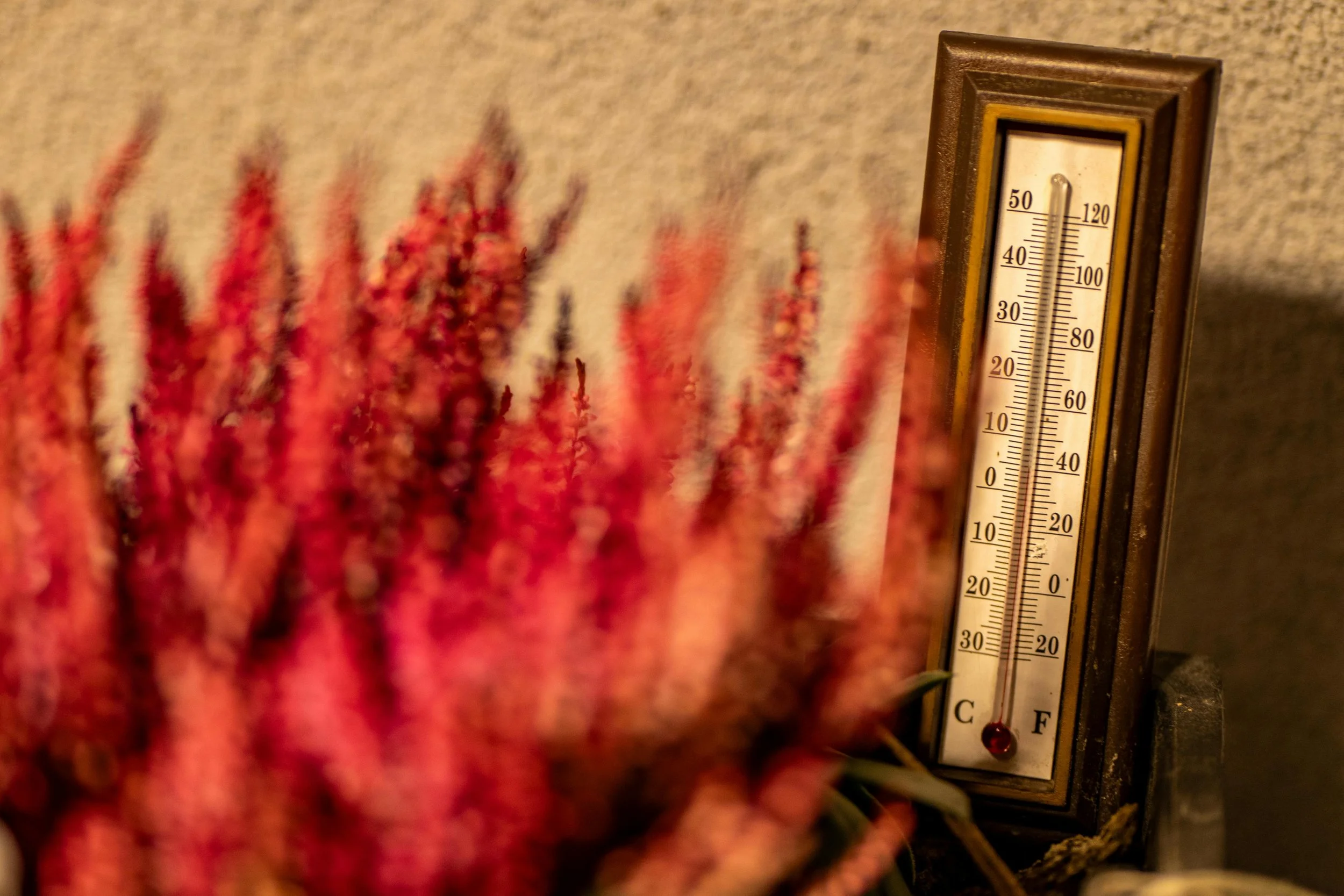
Photo by Vladimir Srajber
On Christmas Eve morning, we packed the Dodge with presents and drove north on Highway 99 to spend the holiday with our grandparents. We spent the first night in Oakland with the Turneys. The next day, we drove to Walnut Creek to see the Sheppards, which was not that far. Mom said it was like killing two birds with one stone.
The Turneys lived in a brown bungalow with yellow trim on a hill above a narrow street. Mom said it was the house she grew up in, and little had changed, kind of like a museum of her childhood. She was an only child. Her dolls still rested on her bed as if she would return soon to play with them. Blue hydrangeas flanked the gray-painted concrete steps to the front porch. In the picture window, Grandma stood in her apron, waving.
We drove the long driveway past the house and parked in front of the detached garage. The garage door was open, and inside, Grandpa wore his faded blue overalls, working at the lathe. Grandpa used to work for the Santa Fe Railroad, but now he was a woodworker like his Swedish ancestors. He made all kinds of gadgets, like Mom’s sock darner, cookie dough roller, and grilled cheese sandwich press. He made beautiful furniture too, like maple coffee tables and chairs. Mom said there wasn’t enough room in our trailer to keep and enjoy them.
Grandpa didn’t know we were there until Grandma came out from the house, waving a dish towel. Grandpa was hard of hearing, even on a quiet day. He was a towering Swede with high cheekbones and a full head of paper-white hair. He picked me up and planted a sloppy kiss on my cheek. Grandma held me at arm’s length, insisting I’d sprouted at least an inch since Thanksgiving.
“I made you a new dress,” she whispered.
While grown-ups unpacked the Dodge, Brother and I sat on the yard swing under a giant pine tree and watched the parade of presents go by.
“Do you know what you got for Christmas?”
“Pretty much,” I said.
“I bet you peeked.”
I rolled my eyes. Brother was the peeker, not me.
The inside of Grandma’s house was warm and delicious. Ham, glazed and pierced with cloves, rested on the gas stove in her narrow green kitchen. Empty serving dishes lined the countertop, waiting to be filled with mashed potatoes and green beans warming in the oven. The table was set with china, silver, crystal, and white linen napkins cinched with holly rings in the dining room. In the middle, Mom placed the candle centerpiece she brought for her mother. I flopped onto the floor by the Christmas tree and spied the unfamiliar wrappings, wondering which presents were mine. When no one was looking, I snuck a fistful of butter mints from the candy dish on the coffee table.
The Turneys had a real Christmas tree taller than Grandpa. Its white lights twinkled among red glass ornaments and tinsel. At the top, a silver star touched the plaster ceiling. The familiar smell of Douglas Fir, ham, and Grandpa’s pipe tobacco imprinted Christmas upon me.
After dinner, we gathered in the living room to unwrap presents. Grandma loved the candlestick I made and placed it on the mantel. It’s funny how a toilet paper roll with glued-on pasta shapes and spray-painted gold can make a grandma so happy.
My best gift was a red Hoppity-Hop from “Santa Claus.” I also got twenty-four pencils with my name on them embossed in silver, a mini stapler, and a ream of newsprint.
Mom liked office products.
I got a new dress, a crisp five-dollar bill, a Lifesaver candy book, and a sterling silver brooch with interchangeable jeweled pieces representing every season and holiday. Mom couldn’t stop talking about that brooch. She told everyone she mail-ordered it in early December and wasn’t sure it would arrive in time for Christmas. Still, it did. How innovative an idea it was, a brooch that changed like the seasons! Mom passed it around, and when it returned to me, I set it on the floor by the couch. That was the last time I saw the brooch but not the last time I’d hear about it.
Before dawn on Christmas morning, Grandpa filled the incinerator behind the garage with empty boxes, crumpled wrapping paper, and lit a match.
After breakfast, Dad told Grandpa all about his job on the California Aqueduct. There were few pauses big enough for an interruption.
“Dad. Dad. Dad.”
Finally he looked up.
“Can we blow up my Hoppity-Hop now? Please? Please? Please?” I set the instructions on his lap.
“It says here, do not inflate the Hoppity-Hop if the temperature outside is below sixty-five degrees Fahrenheit,” he read. He got up and looked at the thermometer on the front porch. “Sorry. It’s only forty-five degrees out there. You’re going to have to wait.”
“How long?” I asked.
“Sixty-five degrees is the magic number. Keep an eye on that thermometer,” he said, smiling, then turned his attention back to Grandpa and the butter mints.
Five minutes, half an hour, an hour later, I waited, but the mercury never rose above fifty-two degrees.
After a lunch of leftovers, we packed the Dodge and waved goodbye to the Turneys. An hour later, we were next in line at the security gates of Rossmoor, a massive retirement community nestled in the hills of Walnut Creek. We always spent Christmas Day with Grandma Libby, Grandpa Glen, and their miniature schnauzer, Maggie.
Rossmoor was a city within a city, with one- and two-story condominiums organized into blocks. It had a golf course, a giant swimming pool, tennis courts, and a clubhouse that moonlighted as an Episcopal church on Sundays. Rossmoor streets were broad for Cadillacs and golf carts, and the landscaping was immaculate. At dusk, herds of deer descended from the hills to mow the lawns and nibble the petunias.
The Sheppards moved to Rossmoor after Mom and Dad married. Before then, they lived in Piedmont, which Dad said wasn’t far from where Mom grew up. Grandpa Glen, a big, tall man with dark hair that never turned gray, had owned a piano store in downtown Oakland, which explained why Dad could play the piano so well. We couldn’t have a piano in our single-wide without it crashing through the floor. But that never stopped Dad from dreaming that someday we’d settle down and live in a house with a foundation strong enough to support a piano. He had a collection of yellow classical music books that took up half a bookshelf in our living room. Sometimes he’d read the music, and his fingers fluttered.
I always thought of Grandma Libby’s house like a donut; the hole in the middle being the kitchen. It was a compact one-story condominium. The carpet was off-white, the drapes thick, and the furniture never moved. Next to the front door was Grandpa’s study, overpowered by a tired red leather chair. Two portraits hung on the wall: Dad’s high school graduation and great-grandpa Jarrett, Grandma’s father. Beside Grandpa’s chair was an oak desk with drawers filled with rubber bands and paper scraps he couldn’t part with. A windowless bathroom smelled of rose-scented guest soap next to the study, lit by a nightlight made from a seashell. Thick silver handrails lined the walls and shower. Grandmas said they kept old people like her from falling. Next to the bathroom was the only bedroom. Twin beds under a pink and white floral bedspread were pushed together to look king-size. Maggie, their dog, slept in her corner on a blanket barricaded by pillows so she couldn’t wander at night. Next was the dining room overlooking the back patio, which transitioned to the living room with its picture window next to the front door. Sometimes, Brother and I got Maggie so worked up, she’d zip around the donut ten times before quitting. Grandpa didn’t mind. He said it got her wiggles out so he didn’t have to walk her as much.
Grandma’s back patio was slippery concrete painted green to look like grass; it had fooled Maggie. A patio set with thick plastic floral cushions and an umbrella with fringe sat in the middle. In the corner by the slider was a mop and bucket used to clean up after the dog. Grandma was funny about that. When Maggie finished her business, Grandma carried her into the bathroom, set her on the counter, and wiped her bottom clean like a baby. Afterward, Maggie got a biscuit.
Grandma Libby’s Christmas tree was fake, trimmed with spun glass musical instruments, exotic birds with feathers, angel hair, and colored lights. While the grown-ups visited in the dining room and Grandma cooked in the kitchen, Brother got permission to turn on the Magnavox TV as long as we kept it low. I didn’t care about watching television. I was more interested in the presents under the tree, double-checking which were mine and guessing their contents by shape. Clothing boxes were disappointing.
After dinner, Grandpa played an Andy Williams Christmas album on his record player to set the mood. When Grandma finished washing dishes, which took forever, we gathered in the living room. Then Grandpa gave a speech. He said he and Grandma were blessed to be surrounded by family, that Santa had been a busy man this year, and something about peace on earth. He took forever, too!
I got a quilted pink bathrobe, a rosebud nightgown, a Tinkerbell nail polish kit, and a deluxe set of Hollywood Starlet paper dolls. Dad got a plaid wool shirt and Mom another scarf to keep her hair from blowing in the car. I don’t remember what Brother got, probably socks.
I played with my paper dolls in the middle of the living room floor. The cheap plastic scissors were blunt and blistered my thumb, but in no time I’d butchered an evening gown for my blonde Hollywood starlet.
“Slow down!” Mom protested. “You have to take your time and carefully cut around the edges. Let me show you how.”
Her slow, meticulous demonstration annoyed me. She followed the dotted lines with her giant hand in my tiny scissors. She trimmed the tabs at exactly 90 degrees, and when she was done, she organized the paper wardrobe into day and evening wear. I lost interest and reached for my Tinkerbell nail polish kit.
“You’re not going to open that, are you?” Mom said. “Grandma doesn’t want red nail polish on her carpet, and neither do I. Put it away.”
Grandma tried to smile.
“Why don’t you tell Grandma what else you got for Christmas?” Mom said.
Grandma Libby was a small, soft-spoken woman. She cleared her throat often. I stood beside her black rocking chair and recalled my gifts, ending with the best gift of all, my red Hoppity-Hop. She squeezed my hand when I told her how devastated I felt because Dad said it was too cold at the Turney’s to blow up my toy. The temperature outside had to be 65 degrees.
“Grandma, do you have a thermometer?”
Grandma cleared her throat. “I think there’s one on the patio if you want to go look.”
“Just a minute,” Mom interrupted. “You didn’t tell Grandma about the brooch you got from Santa.”
I felt deflated like my Hoppity-Hop. I tried but couldn’t picture the brooch in my head anymore to describe it accurately, probably because I’d blocked it from my memory. I told Grandma how it got mixed in with the wrapping papers and ended up in the incinerator, and how Grandpa Turney felt awful about what happened. I told her he wanted to buy me a new one, but Mom said he couldn’t.
“It wasn’t Grandpa’s fault,” Mom said. “You were careless; that’s what happened. If you had put the brooch on the table as I told you, you would be wearing it now!” Mom dug into her purse for her cigarettes and retreated to the back patio with Maggie. Grandma lifted me onto her lap and cleared her throat. “Don’t worry about it, sweetheart,” she said. “I know you didn’t lose it on purpose. It was just an accident.”
Grandma Libby was always my favorite.
While the adults visited at the dining room table and Brother watched TV, I sat on the living room floor with Maggie. I tried not to cry, wondering how many more times I’d be reminded of the Christmas gift I’d grown to hate.
It wasn’t until April that the thermometer outside our single-wide finally reached sixty-five degrees.
